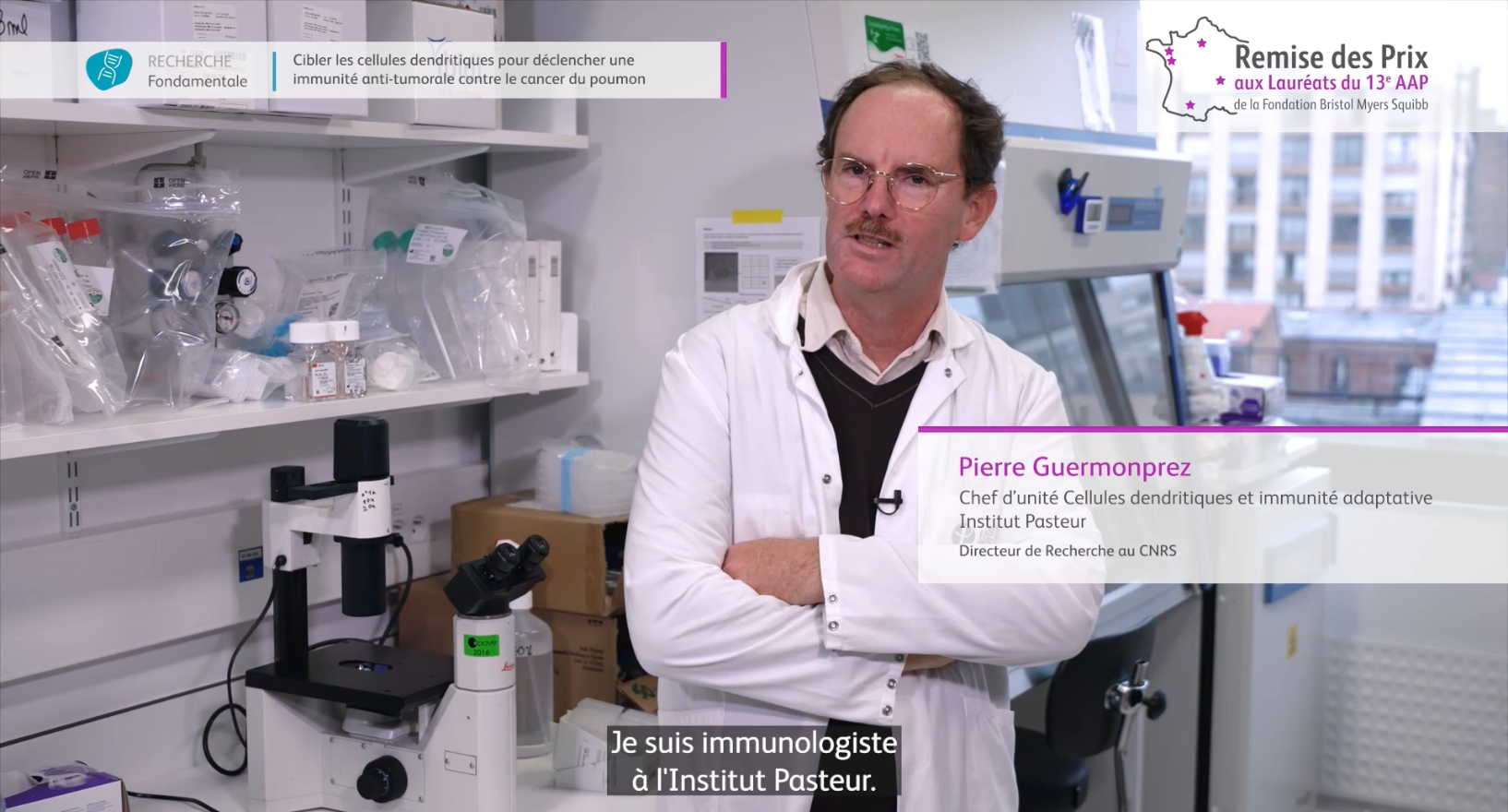
Découvrez l’interview de Pierre Guermonprez

Lung cancer is the leading cause of cancer-related mortalities and morbidities globally. While for metastatic NSCLC immune checkpoint blockade (ICB) is the first-line treatment, only restricted subsets of patients benefit due to emergence of resistance mechanisms. This project aims to develop and evaluate new therapeutic modalities that will evade resistance mechanisms and improve clinical responses. Dendritic cells (DCs) are the sentinels of immune system which upon efficient stimulation activate T cells against tumors. Our lab identified a population of epithelium-associated CD103+ DCs that is recruited during lung cancer development and characterized by an inactive, CCR7low state. Also, CD103+ DCs express multiple inhibitory receptors (IRs) (e.g. SIGLEC-E) which have ligands on tumors and may contribute to their immature stage. Building on this discovery, this project intends: a) to identify IRs activated by tumors in epithelium-associated DCs by implementing a combination of cutting-edge technologies; b) to evaluate the therapeutic benefit of blocking DC-associated immune checkpoints by available or novel recombinant antibodies. Specifically, we will evaluate if these antibodies trigger the formation of CCR7high IL12high DCs and if they activate anti-tumor immunity in pre-clinical models in primary resistance to anti-PD1/PDL1. Altogether our proposal brings forward DC-activation as an actionable pathway of anti-tumor immunity to circumvent resistance to immunotherapies.